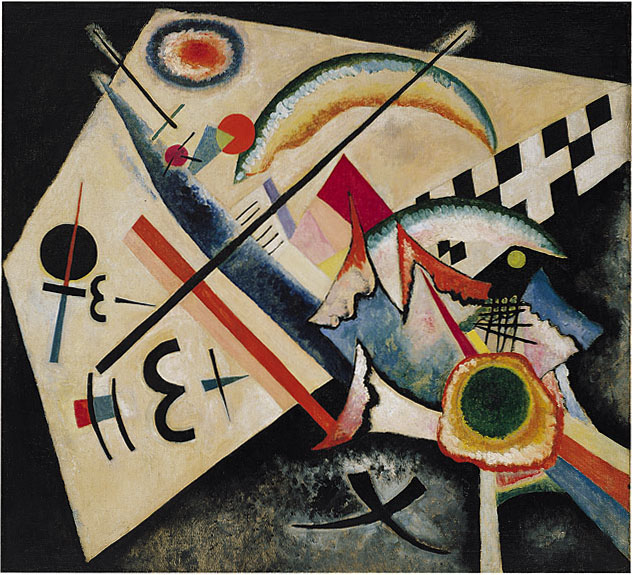
Wassily Kandinsky art, paintings, biography and quotes
The Russian painter and graphic artist Wassily Kandinsky was one of the great masters of modern art, as well as the outstanding representative of pure abstract painting (using only colors and forms) that dominated the first half of the twentieth century.
Here is some related posts:
>>> 30 top examples for creative conceptual....
>>> concept of nature and fine art nature....
>>> sandra mccabe's micronature photography....
>>> best-conceptual-photography-digital....
>>> joseph-beuys
>>> david-lynchs-art-crazy-clown-time
>>> Allan McCollum the Americ...
>>> joseph-beuys-art
>>> surrealism-and-surrealists
>>> abstract-art-and-abstract-expressionism

Wassily Kandinsky was born on December 4, 1866, in Moscow, Russia. His father was a tea merchant. When he was five years old the family moved to Odessa, Russia. The young Kandinsky drew, wrote poems, and played the piano and the cello. Because his family was fond of traveling, Kandinsky got to see the Italian cities of Venice, Rome, and Florence as a young boy. He was also influenced by the imposing Muscovite (from Moscow) buildings such as the Kremlin. Between 1886 and 1892 Kandinsky studied law and economics at the University of Moscow. In 1889 he was a member of a team formed to study the life of the people in the Vologda district in northwestern Russia. He was highly impressed by their folk art and the interior decorations of the village houses. The use of forms and colors became an influence in his art. In 1893 he accepted a position on the university's law faculty.
It was not until 1896, when Kandinsky was thirty years old, that he decided to become an artist. His artistic development was shaped greatly by an exhibition of French impressionist painters that was shown in Moscow in 1895. The impressionists used values of color and light to show their subjects rather than painting in fine detail. The works of Claude Monet (1840–1926) attracted Kandinsky's attention. In Monet's paintings the subject matter played a secondary role to color. It was as though reality and fairy tale were intermixed. That was the secret of Kandinsky's early work, which was based on folk art, and it remained so even as his work became more complex.The year 1910 was crucial for Kandinsky and for the art world. Kandinsky produced his first abstract watercolor. In that work all elements of representation (the actual look of a subject) seem to have disappeared. In continuing his early abstract works he used strong straight-line strokes combined with powerful patches of color.


When World War I (1914–18; a war in which Germany, Austria-Hungary, and Japan fought against Great Britain, France, Russia, and the United States) broke out, Kandinsky returned to Russia. In 1917 he married Nina Andreewsky. During the Russian Revolution (1917), which overthrew the czar, the ruler of Russia, the artist held an important post at the Commissariat (government bureau) of Popular Culture and at the Academy in Moscow. He organized twenty-two museums and became the director of the Museum of Pictorial Culture. In 1920 he was appointed professor at the University of Moscow. The following year he founded the Academy of Arts and Sciences and became its vice president. At the end of that year, the Soviet attitude toward art changed, and Kandinsky left Russia.


In 1922 Kandinsky became a professor at the Bauhaus (a school of art, architecture, and design) in Weimar, Germany. His art from about 1920 to 1924 has been called his architectural period because the shapes he used were more precise than before. There are points, straight or broken lines, single or in bunches, and snakelike, radiating segments of circles. The color is cooler, and more subdued (softer, quieter).


Kandinsky became a German citizen in 1928. In 1929 Kandinsky held his first oneman show in Paris, France, and traveled to Belgium and the French Riviera. In 1930 he had another exhibition in Paris. In 1931 he produced wall decorations for a large architectural exhibition that was held in Berlin, Germany. When the Bauhaus closed in 1932, Kandinsky moved to Berlin. A year after that he moved to Paris. From 1927 to 1933, Kandinsky's paintings were characterized by abundant use of pictorial (like real pictures) signs and softer color. This is called his romantic or concrete period. It led to the last phase of his art, spent in France, which was a synthesis (blending) of his previous periods.
The paintings of his Paris period have splendid color, rich invention, and delightful humor. In 1939 Kandinsky became a French citizen. He died on December 13, 1944, in Neuilly-sur-Seine, France.
Quotes:
+The arts are encroaching one upon another, and from a proper use of this encroachment will rise the art that is truly monumental.
+I value those artists who embody the expression of their life.
+An empty canvas, apparently really empty, that says nothing and is without significance – almost dull, in fact – in reality, is crammed with thousands of undertone tensions and full of expectancy. Slightly apprehensive lest it should be outraged.
+Almost without exception, blue refers to the domain of abstraction and immateriality.
+A parallel between color and music can only be relative – just as a violin can give warm shades of tone, so yellow has shades, which can be expressed by various instruments.
+As a picture painted in yellow always radiates spiritual warmth, or as one in blue has apparently a cooling effect, so green is only boring.
+Absolute green is the most restful color, lacking any undertone of joy, grief, or passion. On exhausted men this restfulness has a beneficial effect, but after a time it becomes tedious.
+Color is the keyboard, the eyes are the harmonies, and the soul is the piano with many strings. The artist is the hand that plays, touching one key or another, to cause vibrations in the soul.
+The organic laws of construction tangled me in my desires, and only with great pain, effort, and struggle did I break through these 'walls around art.'
+The true work of art is born from the Artist: a mysterious, enigmatic, and mystical creation. It detaches itself from him, it acquires an autonomous life, becomes a personality, an independent subject, animated with a spiritual breath, the living subject of a real existence of being.
+The more frightening the world becomes... the more art becomes abstract.
Great like for detail info about his paintings:
wassilykandinsky
Famous artworks:
Composition VII, Composition VIII,Munich-Schwabing with the Church of St. Ursula,Picture with an Archer, Panel for Edwin R. Campbell No. 1, Panel for Edwin R. Campbell No. 4, Panel for Edwin R. Campbell No. 2, The White Dot, Panel for Edwin R. Campbell No. 3, Autumn II, Landscape with Two Poplars, Painting with Troika, Houses at Murnau, Braunlich (Brownish),Sketch for Painting with White Border, Painting with Green Center, Kleine Welten XII (Small Worlds XII), from the portfolio Kleine Welten,Kleine Welten V (Small Worlds V), from the portfolio Kleine Welten, Improvisation No. 30 (Cannons), Kleine Welten I (Small Worlds I), from the portfolio Kleine Welten, The Blue Rider,Kallmnz, Succession