
Pablo Picasso
 bloodinkdiary.wordpress.com
Pablo Diego José Francisco de Paula Juan Nepomuceno María de los Remedios Cipriano de la Santísima Trinidad Ruiz y Picasso, known as Pablo Picasso, was a Spanish painter, sculptor, printmaker, ... Wikipedia
Born: October 25, 1881, Málaga
Died: April 8, 1973, Mougins
Full name: Pablo Diego José Francisco de Paula Juan Nepomuceno María de los Remedios Cipriano de la Santísima Trinidad Ruiz y Picasso
Spouse: Jacqueline Roque (m. 1961–1973), Olga Khokhlova (m. 1918–1954)
Children: Paloma Picasso, Paul Joseph Picasso,Claude Pierre Pablo Picasso, Maya Widmayer-Picasso


Pablo Ruiz y Picasso was born in Malaga,Spain, on October 2, 1881 of Jose Ruiz Blasco Picasso and Maria Picasso y Lopez. He had used his father's last name as his own, but signed his mothers maiden name until 1901 when he decided to stop using Ruiz completely and just go with Pablo Picasso. He had always been an art genius and had been painting since he was ten.
Click on Thumbnails to view whole picture and info on it.
Blue Period
| Picasso made three trips to Paris between 1900 and 1902. He finally moved there in 1904. This is where he went through what is known now as his blue period. During this time he used mainly different shades of blue and portrayed the seedy parts of town including beggars, alcoholics, and prostitutes. | 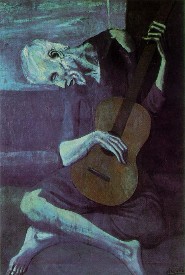 The Old Guitar Player |
| The Rose Period | |
| After he moved to Paris he met Fernande Oliver who influenced the mood of his work from dark and gloomy blues to light and happy reds and pinks which led this period in time to be called the Rose Period. At this time he painted many pictures of a circus that he visited often during his stay in Paris. |  The Acrobats |
| Protocubism | |
| In 1906, Picasso moved to Gosol, Spain where he changed his style. His new works where influenced by Greek, Iberian, and African art. He began to use more geometrical figures in his artwork During this time he also made a picture that resembled fractured glass that was, at the time, a very radical idea. |  Reservoir at Horta |
| Analytic Cubism | |
| Between 1908 and 1911 Picasso and George Braque painted landscape paintings in a new style. This style was termed cubism by a critic who described the work as being made of "little cubes". They created this style by breaking down and analyzing a object. The main color scheme was browns and other muddy colors (monochromatic color). | 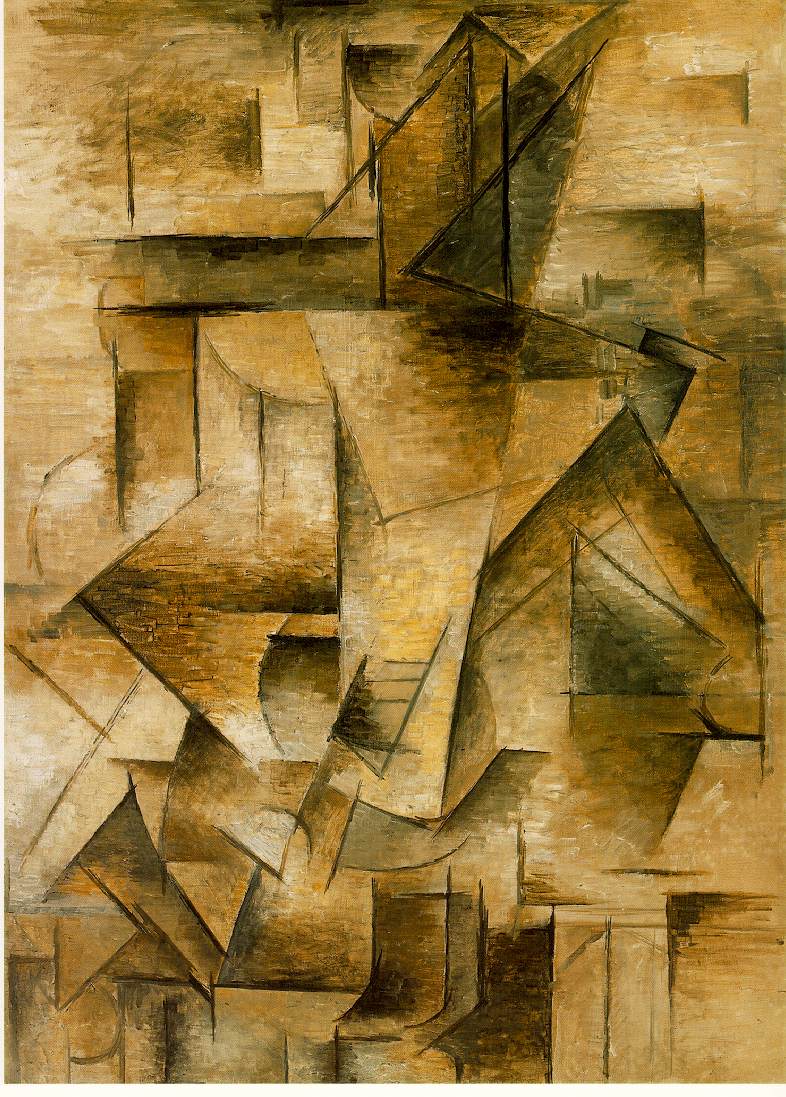 The Guitar Player |
| Synthetic Cubism | |
| In 1912, Picasso began to paste paper and pieces of oilcloth to his paintings and then paint either on them or around them. These where his first collages. This technique is called synthetic cubism. This is a more decorative, colorful style of art. He has done some synthetic cubism, but not particularly a lot. |  Still Life With Chair-Canning |
| Realist and Surrealist | |
| Pablo Picasso has said that he was not a surrealist, but many of his pictures have a surrealist feel to them. During this time (World War I) he went to Rome and met and married Olga Koklova. He painted many realistic pictures of her. Later in the 1920's he painted neoclassical pictures of women and pictures inspired by greek mythology. |  The Dream |
| Guernica | |
| Guernica was a work that was done to express his outrage of the German bombing of the Basque town of Guernica on April 26, 1937 during the Spanish Civil War. The painting is not a portrayal of the actual bombing, but a symbol of the act itself |  Guernica |
| Post War World II | |
| After World War II Picasso moved towards more somber death like pictures. He married painter Francoise Gilot. He had two children with her, Claude and Palmoa. He later met another woman named Jacqueline Rosque whom he married in 1961. He died April 8, 1973. | 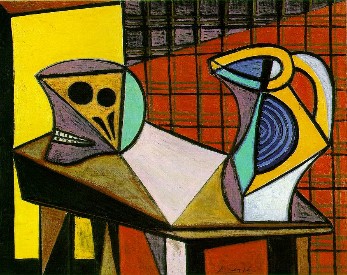 Skull and Pitcher |


